Email Addressinfo@jyotishadda.com
  One Platform for Various Occult Services
 Talk to Astrologers +91-8081817123 /9599110789 Email Addressinfo@jyotishadda.com One Platform for Various Occult Services
Talk to Astrologers +91-8081817123 /9599110789
Talk to Astrologers +91-8081817123 /9599110789 Email Addressinfo@jyotishadda.com One Platform for Various Occult Services
Talk to Astrologers +91-8081817123 /9599110789 P.S. Free & New 1Z0-084 dumps are available on Google Drive shared by RealExamFree: https://drive.google.com/open?id=1H-ix1NByysdXoYA77SohZquXVIPQKmhe
We know that every user has their favorite. Therefore, we have provided three versions of 1Z0-084 practice guide: the PDF, the Software and the APP online. You can choose according to your actual situation. If you like to use computer to learn, you can use the Software and the APP online versions of the 1Z0-084 Exam Questions. If you like to write your own experience while studying, you can choose the PDF version of the 1Z0-084 study materials. Our PDF version can be printed and you can take notes as you like.
Earning the Oracle 1Z0-084 Certification is an excellent way to showcase your knowledge and expertise in the performance tuning of the Oracle Database. Oracle Database 19c Performance and Tuning Management certification demonstrates that you have the necessary skills to maintain an optimal database performance in any situation. Additionally, this certification provides various career opportunities, such as performing the critical role of a Database Performance Analyst or becoming a team leader in developing an application in a high-performance database environment.
>> 1Z0-084 Flexible Learning Mode <<
The time and energy are all very important for the office workers. In order to get the 1Z0-084 certification with the less time and energy investment, you need a useful and valid Oracle study material for your preparation. 1Z0-084 free download pdf will be the right material you find. The comprehensive contents of 1Z0-084 practice torrent can satisfied your needs and help you solve the problem in the actual test easily. Now, choose our 1Z0-084 study practice, you will get high scores.
| Topic | Details |
|---|---|
| Topic 1 |
|
| Topic 2 |
|
| Topic 3 |
|
| Topic 4 |
|
| Topic 5 |
|
| Topic 6 |
|
| Topic 7 |
|
| Topic 8 |
|
| Topic 9 |
|
| Topic 10 |
|
| Topic 11 |
|
| Topic 12 |
|
| Topic 13 |
|
NEW QUESTION # 12
Which two statements are true about space usage in temporary tablespaces?
Answer: B,D
Explanation:
Regarding space usage in temporary tablespaces, the following statements are true:
* A (Correct): When a global temporary table or a sort operation exceeds the available memory, Oracle Database allocates space in a temporary tablespace to store the temporary data or intermediate results.
* E (Correct): Using temporary tablespace groups can prevent insufficient temporary tablespace for sort operations by providing a collective pool of space from multiple temporary tablespaces, which can be used for user sorting operations.
The other options provided have inaccuracies:
* B (Incorrect): Oracle does not provide a mechanism for setting quotas on temporary tablespaces.
Quotas can be set for permanent tablespaces but not for temporary ones.
* C (Incorrect): A sort operation may fail due to insufficient space, but Oracle will attempt to allocate space in the temporary tablespace dynamically. If no space can be allocated, an error is returned rather than a sort failure.
* D (Incorrect): If a session consumes all available temporary tablespace storage, Oracle will not hang the session; it will return an error to the session indicating that it has run out of temporary space.
References:
* Oracle Database Administrator's Guide: Managing Space for Schema Objects
* Oracle Database Concepts: Temporary Tablespaces
NEW QUESTION # 13
Database performance has degraded recently.
index range scan operations on index ix_sales_time_id are slower due to an increase in buffer gets on sales table blocks.
Examine these attributes displayed by querying DBA_TABLES:
Now, examine these attributes displayed by querying DBA_INDEXES:
Which action will reduce the excessive buffer gets?
Answer: C
Explanation:
Given that index range scan operations on IX_SALES_TIME_ID are slower due to an increase in buffer gets, the aim is to improve the efficiency of the index access. In this scenario:
* B (Correct): Re-creating the index using ADVANCED COMPRESSION can reduce the size of the index, which can lead to fewer physical reads (reduced I/O) and buffer gets when the index is accessed, as more of the index can fit into memory.
The other options would not be appropriate because:
* A (Incorrect): Re-creating the SALES table sorted in order of the index might not address the issue of excessive buffer gets. Sorting the table would not improve the efficiency of the index itself.
* C (Incorrect): Using the columns in IX_SALES_TIME_ID as a hash partitioning key for the SALES table is more relevant to data distribution and does not necessarily improve index scan performance.
* D (Incorrect): Hash partitioning the index is generally used to improve the scan performance in a parallel query environment, but it may not reduce the number of buffer gets in a single-threaded query environment.
References:
* Oracle Database SQL Tuning Guide: Managing Indexes
* Oracle Database SQL Tuning Guide: Index Compression
NEW QUESTION # 14
A database instance is suffering poor I/O performance on two frequently accessed large tables.
No Big Table caching occurs in the database.
Examine these parameter settings: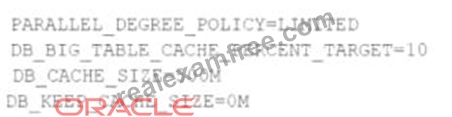
Which are two actions either one of which will allow Big Table caching to occur?
Answer: C,E
Explanation:
Big Table caching is a feature that allows frequently accessed large tables to be cached in memory to improve I/O performance. From the parameter settings provided, Big Table caching is not occurring because DB_BIG_TABLE_CACHE_PERCENT_TARGETis set to 10, which is the minimum threshold for enabling the feature, but the size of the cache is too small for the big tables to be effectively cached.
To enable Big Table caching, one of the following actions could be taken:
* C (Correct):IncreasingDB_BIG_TABLE_CACHE_PERCENT_TARGETto at least 25. This action would allocate a larger percentage of the buffer cache for storing big tables, which could allow for caching large tables and thus improve I/O performance.
* D (Correct):IncreasingDB_CACHE_SIZEto 1G. Since the size of the buffer cache is a determining factor for how much data can be cached, increasing this parameter would provide more memory space for big tables to be cached.
Options A, B, E, and F will not enable Big Table caching because:
* A:IncreasingDB_BIG_TABLE_CACHE_PERCENT_TARGETto 50 without adjusting the overall size of the cache might still not be sufficient if theDB_CACHE_SIZEis not large enough to hold the big tables.
* B:SettingDB_KEEP_CACHE_SIZEto at least 50M only specifies a separate buffer pool for objects with the KEEP cache attribute and does not affect Big Table caching.
* E:andF:Changing thePARALLEL_DEGREE_POLICYtoADAPTIVEorAUTOinfluences the behavior of parallel execution but does not directly enable or influence Big Table caching.
References:
* Oracle Database Performance Tuning Guide:Big Table Caching
* Oracle Database Reference:DB_BIG_TABLE_CACHE_PERCENT_TARGET
* Oracle Database Reference:DB_CACHE_SIZE
NEW QUESTION # 15
Which two types of performance problems are reported by ADDM for PDBS?
Answer: A,B
Explanation:
The Automatic Database Diagnostic Monitor (ADDM) analyzes and reports on various types of performance problems. For Pluggable Databases (PDBs), it can identify issues such as I/O capacity limits which may hinder the overall performance by causing bottlenecks. Additionally, ADDM can report on user I/O waits, which can indicate performance issues related to the time it takes for user queries to read data from the disk.
References:
* Oracle Multitenant Administrator's Guide, 19c
* Oracle Database Performance Tuning Guide, 19c
NEW QUESTION # 16
Which two statements are true about cursor sharing?
Answer: A,D
Explanation:
A: WhenCursor_sharingis set toFORCE, Oracle tries to avoid hard parses by replacing literals in SQL statements with bind variables, even if the original statement didn't include bind variables. This can lead to the use of a single execution plan for multiple executions of a statement with different literal values, which might not be optimal for all executions.
D: Settingcursor_sharingtoEXACTensures that SQL statements must match exactly for them to share a cursor. This setting prevents the use of Adaptive Cursor Sharing (ACS) since ACS relies on the ability to share cursors among similar statements that differ only in their literal values. WithEXACT, there's no cursor sharing for statements with different literals, hence no opportunity for ACS to operate.
References:
* Oracle Database SQL Tuning Guide, 19c
* Oracle Database Reference, 19c
NEW QUESTION # 17
......
1Z0-084 Study Tool: https://www.realexamfree.com/1Z0-084-real-exam-dumps.html
What's more, part of that RealExamFree 1Z0-084 dumps now are free: https://drive.google.com/open?id=1H-ix1NByysdXoYA77SohZquXVIPQKmhe