Email Addressinfo@jyotishadda.com
  One Platform for Various Occult Services
 Talk to Astrologers +91-8081817123 /9599110789 Email Addressinfo@jyotishadda.com One Platform for Various Occult Services
Talk to Astrologers +91-8081817123 /9599110789
Talk to Astrologers +91-8081817123 /9599110789 Email Addressinfo@jyotishadda.com One Platform for Various Occult Services
Talk to Astrologers +91-8081817123 /9599110789 Through years of marketing, our XDR-Engineer study materials have won the support of many customers. The most obvious data is that our products are gradually increasing each year, and it is a great effort to achieve such a huge success thanks to our product development. First of all, we have done a very good job in studying the updating of materials. In addition, the quality of our XDR-Engineer Study Materials is strictly controlled by teachers. So, believe that we are the right choice, if you have any questions about our study materials, you can consult us.
| Topic | Details |
|---|---|
| Topic 1 |
|
| Topic 2 |
|
| Topic 3 |
|
| Topic 4 |
|
| Topic 5 |
|
>> New XDR-Engineer Exam Discount <<
It will provide them with the XDR-Engineer exam pdf questions updates free of charge if the XDR-Engineer certification exam issues the latest changes. If you work hard using our top-rated, updated, and excellent Palo Alto Networks XDR-Engineer PDF Questions, nothing can refrain you from getting the Palo Alto Networks XDR Engineer (XDR-Engineer) certificate on the maiden endeavor.
NEW QUESTION # 11
What should be configured in Cortex XDR to integrate asset data from Microsoft Azure for better visibility and incident investigation?
Answer: A
Explanation:
Cortex XDR supports integration with cloud platforms like Microsoft Azure to ingest asset data, improving visibility into cloud-based assets and enhancing incident investigation by correlating cloud events with endpoint and network data. TheCloud Inventoryfeature in Cortex XDR is designed to collect and manage asset data from cloud providers, including Azure, providing details such as virtual machines, storage accounts, and network configurations.
* Correct Answer Analysis (C):Cloud Inventoryshould be configured to integrate asset data from Microsoft Azure. This feature allows Cortex XDR to pull in metadata about Azure assets, such as compute instances, networking resources, and configurations, enabling better visibility and correlation during incident investigations. Administrators configure Cloud Inventory by connecting to Azure via API credentials (e.g., using an Azure service principal) to sync asset data into Cortex XDR.
* Why not the other options?
* A. Azure Network Watcher: Azure Network Watcher is a Microsoft Azure service for monitoring and diagnosing network issues, but it is not directly integrated with Cortex XDR for asset data ingestion.
* B. Cloud Identity Engine: The Cloud Identity Engine integrates with identity providers (e.g., Azure AD) to sync user and group data for identity-based threat detection, not for general asset data like VMs or storage.
* D. Microsoft 365: Microsoft 365 integration in Cortex XDR is for ingesting email and productivity suite data (e.g., from Exchange or Teams), not for Azure asset data.
Exact Extract or Reference:
TheCortex XDR Documentation Portalexplains cloud integrations: "Cloud Inventory integrates with Microsoft Azure to collect asset data, enhancing visibility and incident investigation byproviding details on cloud resources" (paraphrased from the Cloud Inventory section). TheEDU-260: Cortex XDR Prevention and Deploymentcourse covers cloud data integration, stating that "Cloud Inventory connects to Azure to ingest asset metadata for improved visibility" (paraphrased from course materials). ThePalo Alto Networks Certified XDR Engineer datasheetincludes "data ingestion and integration" as a key exam topic, encompassing Cloud Inventory setup.
References:
Palo Alto Networks Cortex XDR Documentation Portal:https://docs-cortex.paloaltonetworks.com/ EDU-260: Cortex XDR Prevention and Deployment Course Objectives Palo Alto Networks Certified XDR Engineer Datasheet:https://www.paloaltonetworks.com/services/education
/certification#xdr-engineer
NEW QUESTION # 12
When onboarding a Palo Alto Networks NGFW to Cortex XDR, what must be done to confirm that logs are being ingested successfully after a device is selected and verified?
Answer: C
Explanation:
When onboarding aPalo Alto Networks Next-Generation Firewall (NGFW)to Cortex XDR, the process involves selecting and verifying the device to ensure it can send logs to Cortex XDR. After this step, confirming successful log ingestion is critical to validate the integration. The most direct and reliable method to confirm ingestion is to query the ingested logs usingXQL (XDR Query Language), which allows the engineer to search for NGFW log data in Cortex XDR.
* Correct Answer Analysis (A):Conduct an XQL query for NGFW log datais the correct action.
After onboarding, the engineer can run an XQL query such as dataset = panw_ngfw_logs | limit 10 to check if NGFW logs are present in Cortex XDR. This confirms that logs are being successfully ingested and stored in the appropriate dataset, ensuring the integration is working as expected.
* Why not the other options?
* B. Wait for an incident that involves the NGFW to populate: Waiting for an incident is not a reliable or proactive method to confirm log ingestion. Incidents depend on detection rules and may not occur immediately, even if logs are beingingested.
* C. Confirm that the selected device has a valid certificate: While a valid certificate is necessary during the onboarding process (e.g., for secure communication), this step is part of the verification process, not a method to confirm log ingestion after verification.
* D. Retrieve device certificate from NGFW dashboard: Retrieving the device certificate from the NGFW dashboard is unrelated to confirming log ingestion in Cortex XDR. Certificates are managed during setup, not for post-onboarding validation.
Exact Extract or Reference:
TheCortex XDR Documentation Portalexplains NGFW log ingestion validation: "To confirm successful ingestion of Palo Alto Networks NGFW logs, run an XQL query (e.g., dataset = panw_ngfw_logs) to verify that log data is present in Cortex XDR" (paraphrased from the Data Ingestion section). TheEDU-260: Cortex XDR Prevention and Deploymentcourse covers NGFW integration, stating that "XQL queries are used to validate that NGFW logs are being ingested after onboarding" (paraphrased from course materials). ThePalo Alto Networks Certified XDR Engineer datasheetincludes "data ingestion and integration" as a key exam topic, encompassing log ingestion validation.
References:
Palo Alto Networks Cortex XDR Documentation Portal:https://docs-cortex.paloaltonetworks.com/ EDU-260: Cortex XDR Prevention and Deployment Course Objectives Palo Alto Networks Certified XDR Engineer Datasheet:https://www.paloaltonetworks.com/services/education
/certification#xdr-engineer
NEW QUESTION # 13
Which statement describes the functionality of fixed filters and dashboard drilldowns in enhancing a dashboard's interactivity and data insights?
Answer: B
Explanation:
In Cortex XDR,fixed filtersanddashboard drilldownsare key features that enhance the interactivity and usability of dashboards. Fixed filters allow users to refine the data displayed in dashboard widgets by selecting predefined or dynamic values (e.g., time ranges, severities, or alertsources), adjusting the scope of the data presented. Dashboard drilldowns, on the other hand, enable users to interact with widget elements (e.
g., clicking on a chart bar) to gain deeper insights, such as navigating to detailed views, other dashboards, or executingXQL (XDR Query Language)searches for granular data analysis.
* Correct Answer Analysis (C):The statement in option C accurately describes the functionality:Fixed filters let users select predefined or dynamic values to adjust the scope, ensuring users can focus on specific subsets of data (e.g., alerts from a particular source).Dashboard drilldowns provide interactive insights or trigger contextual changes, like linking to XQL searches, allowing users to explore related data or perform detailed investigations directly from the dashboard.
* Why not the other options?
* A. Fixed filters allow users to select predefined data values, while dashboard drilldowns enable users to alter the scope of the data displayed by selecting filter values from the dashboard header: This is incorrect because drilldowns do not alter the scope via dashboard header filters; they provide navigational or query-based insights (e.g., linking to XQL searches).
Additionally, fixed filters support both predefined and dynamic values, not just predefined ones.
* B. Fixed filters limit the data visible in widgets, while dashboard drilldowns allow users to download data from the dashboard in various formats: While fixed filters limit data in widgets, drilldowns do not primarily facilitate data downloads. Downloads are handled via export functions, not drilldowns.
* D. Fixed filters allow users to adjust the layout, while dashboard drilldowns provide links to external reports and/or dashboards: Fixed filters do not adjust the dashboard layout; they filter data. Drilldowns can link to other dashboards but not typically to external reports, and their primary role is interactive data exploration, not just linking.
Exact Extract or Reference:
TheCortex XDR Documentation Portaldescribes dashboard features: "Fixed filters allow users to select predefined or dynamic values to adjust the scope of data in widgets. Drilldowns enable interactive exploration by linking to XQL searches or other dashboards for contextual insights" (paraphrased from the Dashboards and Widgets section). TheEDU-262: Cortex XDR Investigation and Responsecourse covers dashboard configuration, stating that "fixed filters refine data scope, and drilldowns provide interactive links to XQL queries or related dashboards" (paraphrased from course materials). ThePalo Alto Networks Certified XDR Engineer datasheetincludes "dashboards and reporting" as a key exam topic, encompassing fixed filters and drilldowns.
References:
Palo Alto Networks Cortex XDR Documentation Portal:https://docs-cortex.paloaltonetworks.com/ EDU-262: Cortex XDR Investigation and Response Course Objectives Palo Alto Networks Certified XDR Engineer Datasheet:https://www.paloaltonetworks.com/services/education
/certification#xdr-engineer
NEW QUESTION # 14
Based on the SBAC scenario image below, when the tenant is switched to permissive mode, which endpoint (s) data will be accessible?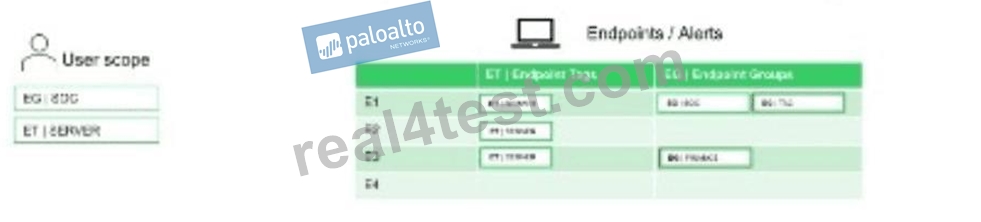
Answer: B
Explanation:
In Cortex XDR,Scope-Based Access Control (SBAC)restricts user access to data based on predefined scopes, which can be assigned to endpoints, users, or other resources. Inpermissive mode, SBAC allows users to access data within their assigned scopes but may restrict access to data outside those scopes. The question assumes an SBAC scenario with four endpoints (E1, E2, E3, E4), where the user likely has access to a specific scope (e.g., Scope A) that includes E1, E2, and E3, while E4 is in a different scope (e.g., Scope B).
* Correct Answer Analysis (C):When the tenant is switched to permissive mode, the user will have access toE1, E2, and E3because these endpoints are within the user's assigned scope (e.g., Scope A).
E4, being in a different scope (e.g., Scope B), will not be accessible unless the user has explicit accessto that scope. Permissive mode enforces scope restrictions, ensuring that only data within the user's scope is visible.
* Why not the other options?
* A. E1 only: This is too restrictive; the user's scope includes E1, E2, and E3, not just E1.
* B. E2 only: Similarly, this is too restrictive; the user's scope includes E1, E2, and E3, not just E2.
* D. E1, E2, E3, and E4: This would only be correct if the user had access to both Scope A and Scope B or if permissive mode ignored scope restrictions entirely, which it does not. Permissive mode still enforces SBAC rules, limiting access to the user's assigned scopes.
Exact Extract or Reference:
TheCortex XDR Documentation Portalexplains SBAC: "In permissive mode, Scope-Based Access Control restricts user access to endpoints within their assigned scopes, ensuring data visibility aligns with scope permissions" (paraphrased from the Scope-Based Access Control section). TheEDU-260: Cortex XDR Prevention and Deploymentcourse covers SBAC configuration, stating that "permissive mode allows access to endpoints within a user's scope, such as E1, E2, and E3, while restricting access to endpoints in other scopes" (paraphrased from course materials). ThePalo Alto Networks Certified XDR Engineer datasheet includes "post-deployment management and configuration" as a key exam topic, encompassing SBAC settings.
References:
Palo Alto Networks Cortex XDR Documentation Portal:https://docs-cortex.paloaltonetworks.com/ EDU-260: Cortex XDR Prevention and Deployment Course Objectives Palo Alto Networks Certified XDR Engineer Datasheet:https://www.paloaltonetworks.com/services/education
/certification#xdr-engineer
NEW QUESTION # 15
Log events from a previously deployed Windows XDR Collector agent are no longer being observed in the console after an OS upgrade. Which aspect of the log events is the probable cause of this behavior?
Answer: B
NEW QUESTION # 16
......
Our worldwide after sale staff will be online for 24/7 and reassure your rows of doubts on our XDR-Engineer exam questions as well as exclude the difficulties and anxiety with all the customers. Just let us know your puzzles and we will figure out together. You can contact with us at any time and we will give you the most professional and specific suggestions on the XDR-Engineer Study Materials. What is more, you can free download the demos of the XDR-Engineer learning guide on our website to check the quality and validity.
Reliable XDR-Engineer Exam Guide: https://www.real4test.com/XDR-Engineer_real-exam.html